Most organisations bought the AI licenses. But across the industry, adoption is stalling — teams either over-edit every output in hesitation or accept generic answers without applying domain judgment. If that sounds familiar, you’re not alone.
Play · AI · Play is a 90-minute facilitated intervention that builds confidence and sharpens AI posture. Powered by our BYOD (Bring Your Own Deliverable) framework: we don’t run abstract exercises. Teams bring in-flight work due that week — using the session to break through the blank-page problem, unblock complex tasks, and build momentum under expert facilitation.
Events celebrate. Practices transform. When your people investment is structured as a repeatable practice alongside the moments that matter, the impact doesn’t fade by Monday — it compounds every quarter.
Where connection starts.
Real capability, built session by session.
We Deliver L&D With Engagement.
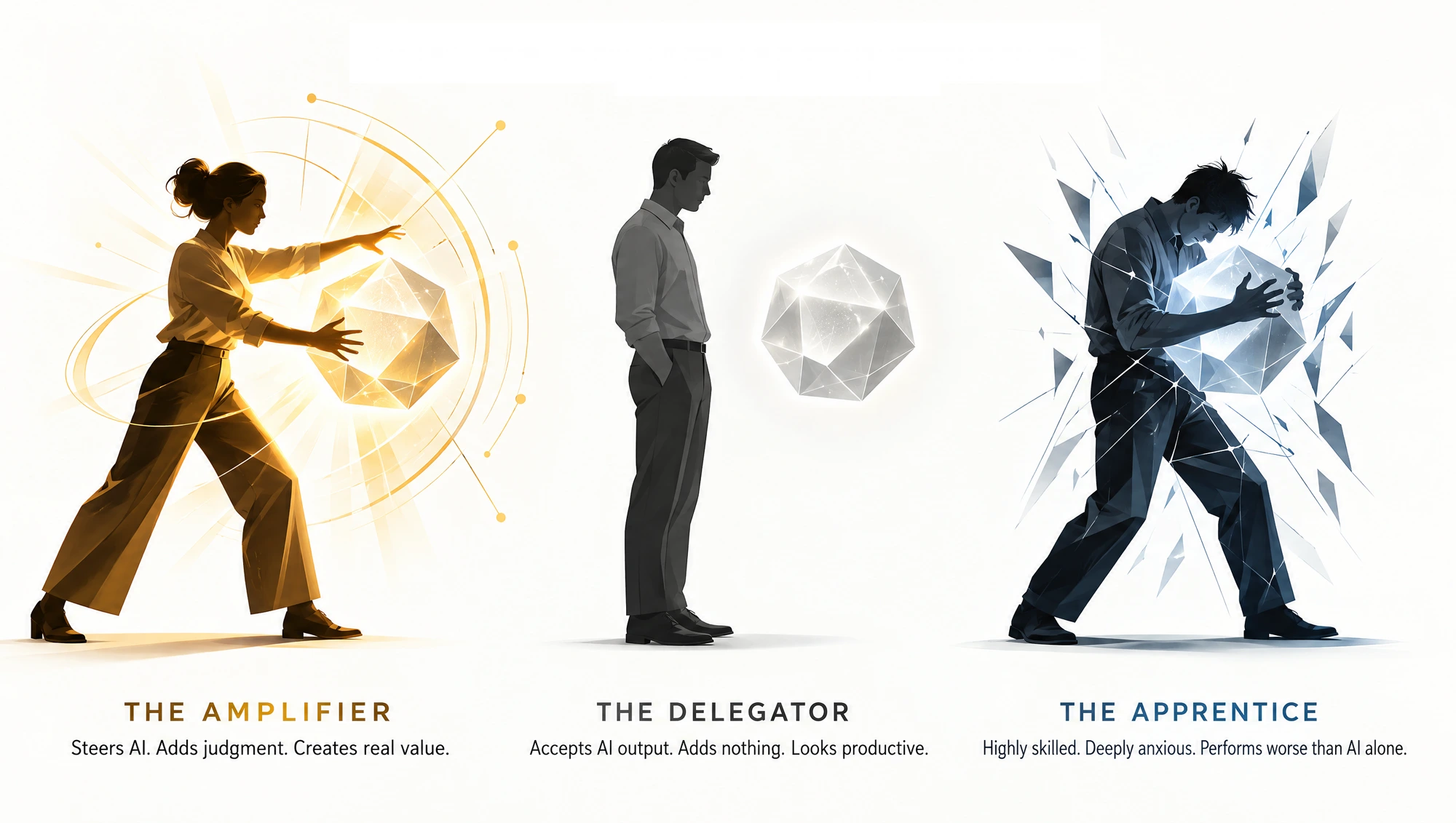
When researchers watched real knowledge workers use AI on real tasks, productivity didn’t split by seniority or skill. It split by behavioural posture — and only one posture actually beat the AI baseline.
Active thought partners. They steer workflows, challenge assumptions and use AI to extend judgement rather than replace it. This is the target state.
Lazy execution. Productive on the surface, but they blindly accept output and add zero human judgement. The errors ship downstream. Passive delegation.
High skill — but paralysed by friction. They micro-manage and over-edit baseline output, so the task takes longer than if AI had never been involved. Performance anxiety.
Start where it hurts. Pick the pressure you feel most — then model exactly what recovering it is worth.
Most teams have the tools. What’s missing is the confidence to use them well. Play . AI . Play builds the Amplifier reflex — not through tutorials, but through practice.
Model your ROI →Across the industry, the productivity gains from AI licences aren’t materialising the way leaders expected. The problem isn’t access — it’s anxiety. We change the behavioural posture so teams actually engage.
Model your ROI →Hours disappearing into defensive re-prompting, manual reformatting and context-switching. Most of it isn’t tracked. All of it is recoverable.
Model your ROI →Offsites, team days, Fun Fridays — the energy fades by Monday. Micro-dosed sessions compound. The budget stays the same. The results don’t.
Model your ROI →People leave when they stop growing. Play . AI . Play gives teams a reason to stay — real skill-building, not performative perks.
Model your ROI →When people don’t feel safe to speak up, every AI tool, every process, every meeting underperforms. Safety isn’t a policy. It’s a practice.
Model your ROI →Every session is built on three things that technical training can’t touch: safety, movement, and practice. The format adapts to your space — online, indoors, or outdoors — and to your team’s reality. Whether your people are in the same room or spread across time zones, the method works.
A level playing field. No titles, no tenure, no technical edge. Your VP and your newest hire start equal — which is exactly where psychological safety is born.
Status reset · mixed podsMovement gets people out of their heads and into their bodies. 3500+ steps per head shifts the brain into the state it needs to stop defending and start thinking.
3500+ steps · 90 minHands-on momentum on in-flight tasks. We don’t ask engineers, marketers, or managers to prompt around hypothetical scenarios. Participants bring work they actually care about — a draft proposal, a messy handover log, or a complex analysis. As facilitators, we introduce targeted steering, prompt structuring, and red-teaming techniques. As the domain experts, your teams apply their professional judgment to refine the output — turning a stalled task into an accelerated working draft.
In-Flight Work Unblocked · Active Red-Teaming · SME Judgment FirstYou are the subject matter experts. We are the behavioral and facilitation specialists.
Traditional training stalls because it detaches learning from daily pressure. With BYOD (Bring Your Own Deliverable), we help your people apply new AI reflexes directly to the tasks already sitting on their desks — breaking initial inertia so they can finish faster with higher quality.
Participants bring an active task from their weekly backlog — a brief, an outline, a comparative analysis, or an SOP. No simulated case studies. The context is 100% relevant to them.
Familiar Context · Immediate Relevance15 minutes of structured, spatial movement — reflex challenges, light agility, coordination drills — clears cognitive fatigue and primes the mind for high-focus engagement.
State Reset · Fresh PerspectiveA guided 40-minute sprint using structured AI workflows. We guide participants through decomposition, constraint setting, and iterative prompting to turn a daunting task into a workable first draft.
Inertia Broken · Rapid ProgressThe AI doesn’t get the final say — the human expert does. Teams critically evaluate the draft, challenge assumptions, and fix inaccuracies, internalizing a repeatable workflow for future tasks.
Human-Led · Critical AuditOur play formats work outdoors, indoors, and online — designed for corridors, meeting rooms, open grounds, or distributed teams across time zones. Every session is self-refereed, radically inclusive across fitness levels, gender, and seniority, and adapts to whatever space you have. The format changes. The method doesn’t.
No referees, no hierarchy. Participants own every call — trust and accountability are built into the rules, not enforced from above.
Every fitness level, gender, and age in the same session. The design makes exclusion impossible.
A corridor, a car park, a cafeteria, a video call. Small spaces and remote screens become the playing field.
Heavy, oily snacks and sugary drinks spike and then crash blood glucose — the exact opposite of the alert, focused state you need for real learning. Fuel is not catering. It’s a performance input.
High-grade, well-timed fuel keeps the nervous system regulated and conversation flowing. We architect it in three tiers so finance can dial the spend without ever touching the quality of the intervention.
Per person, per session. Plug any tier into the ROI engine below.
Every input is yours to move. The engine recalculates productivity recovered, the value it unlocks and how little of that value it costs to run — live.
What’s the typical weekly productivity drag in your team?
The share of dragged time reclaimed by turning passive ‘AI Delegators’ into active ‘AI Amplifiers’ and breaking departmental silos. Pick a number you think is realistic.
How often can your calendar accommodate a 90-minute session?
One session per month — the most common cadence for sustained behavioural change.
At 15 people per session, monthly cadence → 4 sessions needed to cover all 60 participants.
The programme is funded entirely by the value it unlocks — no net new cash leaves the business.
Your entire programme is funded by just 17% of the capacity it unlocks.
All figures are illustrative projections, not guaranteed outcomes. Actual results depend on organisational context, participant engagement, and implementation consistency. Read full disclaimer ↑
Prove the posture shift on one pod before you scale. Three sessions across 90 days, one cohort of 15, fully measured — a decision a department head can sign off without a committee.
When teams are under pressure, the hardest part of any complex task is getting off the blocks — overcoming the friction of structuring, synthesizing, and starting. That’s why Play · AI · Play runs on BYOD (Bring Your Own Deliverable). We don’t ask your teams to pause their work; we ask them to bring a real, pending task that is causing cognitive drag. We are not there to do their jobs — they remain the subject matter experts. Our role is to facilitate the session, reset their energy through movement, and guide them through structured AI workflows that break the initial inertia. Teams walk away not with theoretical notes, but with significant progress on an actual deadline and a repeatable method to do it again tomorrow.
Every session has an indoor contingency built in. The Triad — unity, vitality, AI precision — runs just as well in a hall or large meeting room; the sport simply adapts. We confirm the backup space during scoping so a forecast never cancels a session.
The 90-minute format is designed for exactly this. It slots into a single block, cohorts are pod-sized, and sessions are rescheduled at no penalty with reasonable notice. Micro-dosing means one moved session never derails the behavioural arc.
All curated and artisanal tiers are sourced from vetted, FSSAI-compliant partners with cold-chain and freshness controls. Dietary, allergen and cultural preferences are captured up front. If you prefer, Tier ₹0 lets you run your own trusted pantry within our structure.
No. The prompt-sparring is LLM-neutral and behaviour-first — it works whether your stack is Copilot, Gemini, Claude, ChatGPT or an internal model. We build the Amplifier reflex, not product training, so it stays valid as your tooling changes.
Yes — radically inclusive by design. Every session is self-refereed, mixed-gender, and low-impact. The formats flex for every fitness level. A level playing field is the whole point — it only works when everyone can play.
Same play-powered engine, pointed at a different outcome. Explore the format that fits your team’s moment.
Sharper decisions & creative problem-solving — play that rewires how teams think, not just how they feel.
Explore →Rebuild belonging, trust and workplace culture across hybrid, multi-generational teams.
Explore →POSH & respectful-workplace sensitisation that people actually remember — compliance without the cringe.
Explore →Pure, inclusive play. The reset button for energy, connection and joy — no agenda beyond a great team day.
Explore →I keep watching organizations treat the AI productivity gap as a skills problem. Buy the licenses. Run the training. Send the prompt cheatsheet. Three months later — the numbers barely move.
Here’s the uncomfortable truth the data keeps pointing at: it was never about the tools. It’s about how people feel when they use them.
I know because I feel it too. I’m a founder and a business leader, and there are days when I catch myself lazy-prompting, avoiding the deeper work, or wondering if I’m using these tools as well as I should be. If someone building an AI-focused practice struggles with this, I know for a fact it’s happening across every floor of every organisation in the country.
When KPMG and UT Austin watched 523 professionals actually work with AI, the room split three ways.
About a quarter became Apprentices — skilled people so anxious about being seen to “just use AI” that they micro-managed every output until the task took longer than doing it by hand.
Another quarter became Delegators — they pasted the prompt, took whatever came back, and shipped it without a second thought. Zero judgement. Zero value added.
Only about half became Amplifiers: people who pushed back on the model, steered it, and used it to sharpen their own thinking.
Notice what separates the three. It isn’t IQ, seniority, or technical fluency. It’s whether the person feels safe enough to think clearly.
The Apprentice is scared — over-correcting everything because they’re terrified of looking like they relied on a machine. The Delegator has quietly checked out — disengaged, avoiding ownership, hoping nobody looks too closely. The Amplifier is calm enough to trust the tool and confident enough to challenge it.
You cannot PowerPoint someone into that state. You have to move them into it — literally.
Movement does something no classroom, webinar, or slide deck can: it gets people out of their heads.
Put mixed teams into a self-refereed session where nobody has an advantage — no titles, no tenure, no technical edge — and three things happen fast: status disappears, energy shifts, and people start taking small risks in front of each other again.
That last part is everything. Because that’s psychological safety. And psychological safety is the precondition for the Amplifier posture.
We keep it to 90 minutes on purpose. A day-long offsite spikes morale and fades by Monday. A micro-dose, repeated over weeks, compounds. Each session layers in hands-on AI practice — teams building the Amplifier reflex on real prompts and real output, in a space where getting it wrong costs nothing.
The behaviour transfers back to the desk because it was learned in the body, not memorized from a slide.
The drag is real and quantifiable. A few hours per week, per person, lost to anxiety-driven rework, defensive re-prompting, and avoidance. Recover even a third of that across a cohort and you unlock the equivalent of several full-time hires worth of capacity — at a fraction of the cost of actually hiring them.
The programme doesn’t add to the budget. It reallocates capacity you already paid for and are currently leaking.
So no — don’t buy another tool. Your people already have the tools. What they don’t have yet is the posture to use them.
That’s a 90-minute problem. Let’s go play.